PRINCIPLESProduct Advocacy & Storytelling
Product advocacy is an important piece of product strategy and innovation work.
by Martina Fugazzotto
My Product experience & expertise is divided into three parts of a whole:
1. Product Incubation
Product strategy, new product development, testing and market fit, prototyping, pitching through to funding of a new product
2. Product Design
Designing the experience, mapping user flows, setting up design systems & tokens, building design prototypes and working with engineering to get them made
3. Product Advocacy
Building excitement about new products & features, encouraging adoption, communicating value, training and educating, learning and listening to reactions
I’ve thrived in roles that allow me to flow through all three steps of this journey. Sometimes the flow is a fast, constant cycle of incubate → create → advocate → repeat (ex: My role in the News Corp product innovation lab from 2018-2022), and sometimes it’s a 4-year long process that culminates in a massive product launch requiring constant product adoption and advocacy work (Ex: When I launched the new BBC subscription product in 2025). The following is an overview of my product advocacy thinking.
My Principles for Product Advocacy:
1. Communicate the value of new products, not the features
New experiences on their own can be scary. But translating those experiences to value improves adoption, excitement, and understanding. The editors are not getting a “new set of CMS tools”, they’re getting a more efficient workflow with shorter time to publish. The user isn’t getting “a system of entity tagging to power a personalized feed”, they’re getting an app that shows them exactly what they want to see when they want to see it. The same goes for training: don’t train on step-by-step-how-to-use-each-feature. Train on “tell me what you need to accomplish and I will teach you the right workflow”.
2. Simplify concepts and speak memorably
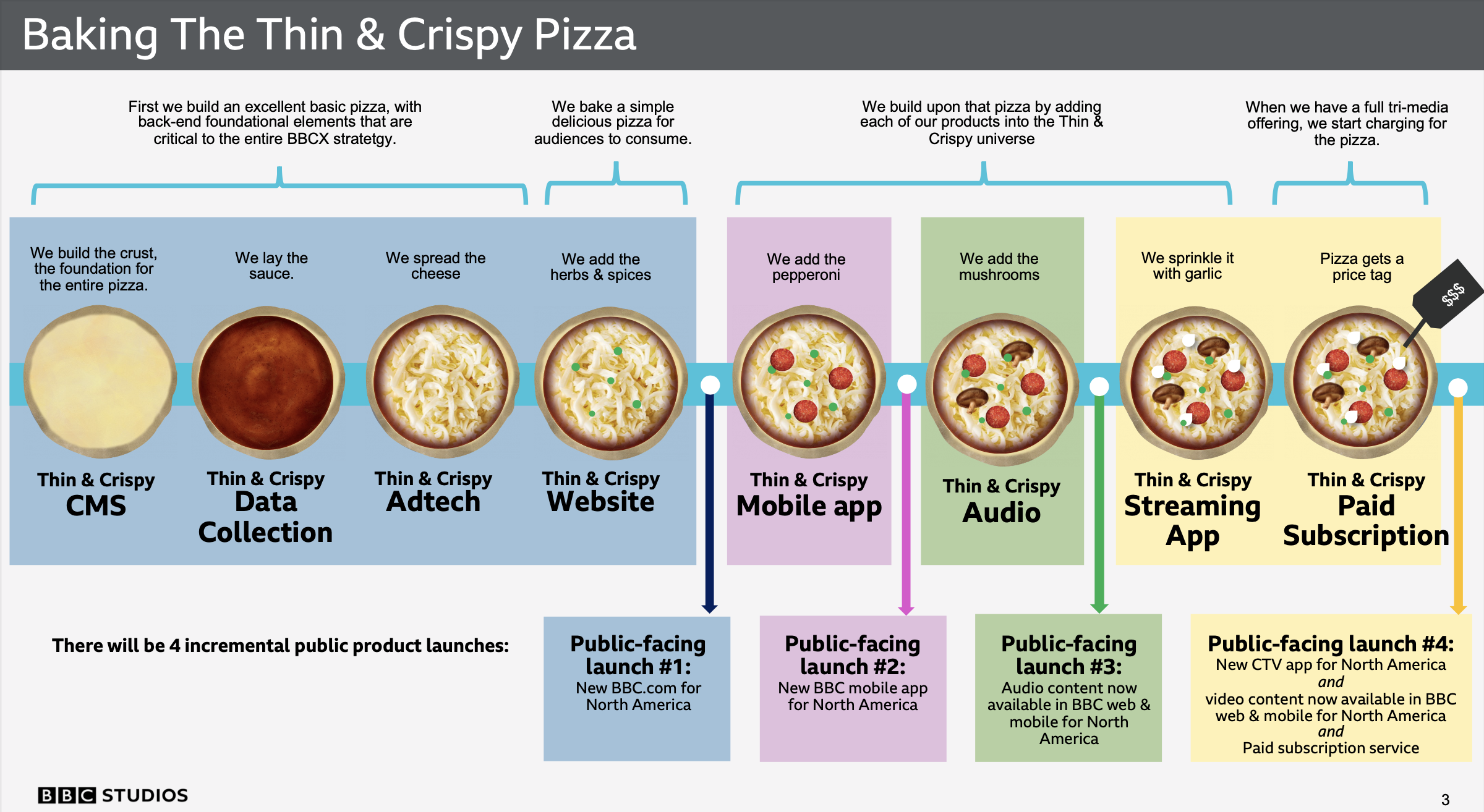
One of my superpowers has always been translating between engineers and non-engineers. Make technical concepts simple to understand, and know which technical information is important to share and which information is just noise. I like to create memorable analogies, like the Thin & Crispy visual plan I created and socialized for rolling out the BBC product suite like a pizza:
3. Customize advocacy for different internal & external needs
Different audiences need different types of advocacy at different times in the process. During my time leading the 4-year long BBC product transformation, advocacy looked like:
Pre launch
Editorial teams needed to understand the changes that would be coming to their CMS, so they could be trained in advance and making necessary staffing and process adjustments
Sales teams needed to understand what our product would be like next year so they could start selling into the new experience
Customer service teams needed to be trained on the new product experience so they would be ready to serve customers on launch day
Executives needed confidence in what we were building and ongoing progress views
Current loyal customers were offered a beta experience for a chance to test our product advocacy + generate a feedback loop
During launch
The comms team needed a core understanding of how to communicate the new product for press releases and interviews
Internal teams needed guidance on how to talk about the product launch everywhere from LinkedIn to panel Q&As
Our current product users needed communication about the changes, training and walkthroughs, new customer service
Users of the products that would be deprecated needed clear, empathic journeying through closure of their product + adopting the new one
The new potential users we hoped to reach needed an introduction to the new product
The industry needed to be educated & excited about our new product
Post launch
Customers needed ongoing support and feedback handling
Comms team needed to understand the product so they can answer questions and handle any PR issues
Internal teams needed access to documentation, trainings, and support for the new product
Product Advocacy in Practice
This advocacy and communication comes in the forms of:
Internally available
Product vision written documents and visuals
Product copywriting documentation
Interactive prototypes
Product walkthrough videos
Live training sessions
Training videos & written documentation
Developing a support community
Talking points for employees to use for interviews, conferences, etc
An accessible product advocacy hub to store all materials
A system for feedback loops
Externally available
A product help center with training videos
A product knowledge base
Social media content about the product
Content product marketing
Visuals and messaging for publicity use
Sales enablement materials
A system for feedback loops
Hi, I’m Martina 👋
I’m a product strategy creative who has been enabling thoughtful digital products for over 20 years.